Three estimates arrive in your inbox. The totals are far apart, and every document looks different. One is two pages long, one is eleven, and one is a single paragraph with a number at the bottom. Comparing contractor estimates by price alone might seem easy, but it is one of the surest ways to compare apples to oranges.
Here is the pattern to watch for. ProConstruction, a Texas builder, says bids that land about 30% below the market average often signal missing scope, low-quality material assumptions, or a contractor planning to recover margin through change orders after you have committed. That is one contractor’s view, but similar warnings run through most bid-comparison guides. The cure is the same each time: put every estimate on equal terms before you look at the total.
This guide shows how to do that in four passes: scope, allowances, exclusions, and payment schedules. You will get a worked example, a comparison worksheet, and a checklist. Sources were checked in November 2026. Prices and rules vary by state and city, so use the method for your own bids.

Quick answer
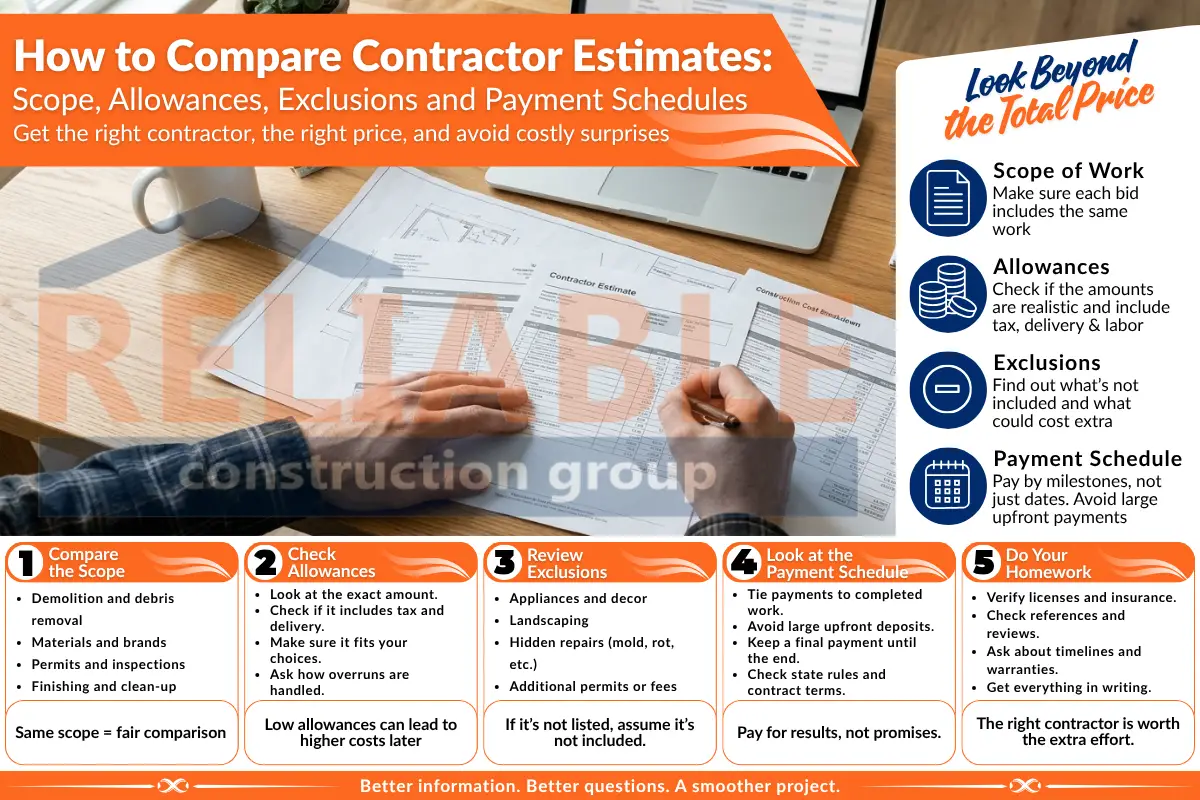
Give every bidder the same scope, then compare four things line by line: what work is included, what each allowance assumes, what is excluded, and how payments are scheduled. Adjust each bid for low allowances and missing items before you compare totals. The cheapest bid often wins only because something is left out.
Level the playing field first
The best comparison starts before the estimates arrive. Jaspector says every bidder should receive the same scope notes, drawings, and owner expectations. ProConstruction suggests giving each contractor the same scope document, or a work breakdown, so each one prices exactly the same work. When bids come back in different formats, ask each bidder to resubmit in the same itemized layout.
Detail is protection. Jaspector says a strong proposal usually covers scope, materials, exclusions, allowances, schedule assumptions, payment terms, and warranty language. BuildZoom adds that if a proposal does not give enough detail on scope, prices, exclusions, or allowances, you should ask for more. The FTC also tells homeowners to get written estimates from several firms and ask why prices differ, rather than picking the lowest bid automatically.
Small first step
Before you read any totals, copy each bid’s line items into one spreadsheet or the worksheet table later in this guide. Do not decide anything until the rows line up.
Pass 1: Scope
Scope is the list of work each contractor agrees to perform. BuildZoom flags a scope that is too vague, such as “kitchen remodel” with no details, as a sign of missing information. Block Renovation says bids often look comparable until you compare assumptions line by line, and suggests lining them up across major categories and noting where each one is silent.
| Scope area | What to compare |
|---|---|
| Demolition and debris removal | Who removes what, and whether disposal is included |
| Structural work | Whether engineering, framing, or beams are included, and who pays for them |
| Electrical | Scope of work, panel capacity, and fixture counts |
| Plumbing and mechanical | Fixture counts, rough-ins, and any relocation of lines |
| Finishes | Product grades, brands, and quantities, not just “standard” or “mid-grade” |
| Permits and inspections | Who applies, who pays, and who schedules the inspections |
If one bid is silent on an item, do not assume it is included. Ask in writing. The point is not to catch anyone out. It is to make sure every contractor is pricing the same house.
Pass 2: Allowances
An allowance is a budget placeholder for something you have not chosen yet, such as tile, lighting, or plumbing fixtures. BuildZoom describes allowances as placeholders for items not yet selected and notes that low ones can lead to change orders or budget overruns later. Building Advisor warns that some contractors use unrealistically low allowances to present a low bid, knowing the owner will likely pick more expensive materials.
Block Renovation makes the point with a pair of numbers: a $4,000 tile allowance and a $12,000 tile allowance describe different projects. A column at AskTheBuilder says the usual cause of this frustration is artificially low allowance numbers, and notes that choosing the items during planning makes the bids a true comparison of apples to apples.
Questions to ask about each allowance
- What exactly does this allowance cover, including delivery, installation, and accessories?
- What quantity does it assume, and what is the unit price beyond it? A property manager’s bid guide suggests asking exactly this.
- What happens if I choose something more expensive, and what happens if I choose something cheaper?
- Is there a markup on materials or items I buy myself?
Example (our arithmetic, an estimate): three bids for the same bathroom come in at $48,000, $52,000, and $55,000. Their tile allowances are $4,000, $8,000, and $12,000, and you plan to choose tile that costs about $12,000. Adjusting each bid to your real choice gives $56,000, $56,000, and $55,000. The lowest bid is now the highest, and the highest is now the lowest.
| Bid A | Bid B | Bid C | |
|---|---|---|---|
| Quoted total | $48,000 | $52,000 | $55,000 |
| Tile allowance | $4,000 | $8,000 | $12,000 |
| Shortfall against a $12,000 choice | $8,000 | $4,000 | $0 |
| Adjusted total | $56,000 | $56,000 | $55,000 |
To reduce the guesswork, pick your finishes early. An ideas booklet for choosing finishes can help you narrow options, and a showroom visit turns vague allowances into real prices. A cabinet-focused project shows how much cabinet choices alone can shape a kitchen budget.
Pass 3: Exclusions
Exclusions list what is not in the price. According to ProConstruction, exclusions like permits and waste removal appear frequently in lower bids and become costly change orders later. Its advice is to list every exclusion from each bid and price those items separately, so you work with complete numbers. Journeyman HQ similarly says to check that items such as permit fees or landscaping repair are not hiding in the excluded work.
| Common exclusion | Why it matters |
|---|---|
| Permits and inspection fees | Can be assigned to either side, and the cost varies by city |
| Debris removal and dumpsters | A missing line item can become a surprise invoice |
| Protection and cleanup | Floors, furniture, and the dust barrier around the work area |
| Engineering or design fees | Often a separate cost, especially for structural changes |
| Patching and painting after trades | A common gap between trades |
| Testing for hazards | Lead or asbestos testing in older homes, if needed |
| Appliances and installation | Whether they are supplied, installed, or both |
Then ask the question that exposes the rest: “What is not included in this price?” A good contractor can answer it in writing. For a kitchen, a kitchen job usually touches several trades, so check each trade’s exclusions separately. The same goes for a bathroom job and a basement job.
Pass 4: Payment schedules
Two bids at the same price can carry very different risk depending on when you pay. The FTC suggests making payments contingent upon completion of defined amounts of work, so that a late project delays the next payment. The FTC’s scam warning page says a contractor who wants cash up front is a reason to walk away and notes that some states limit down payments. The Arizona Attorney General advises never paying for the entire project before work begins and not paying more than one-third as a down payment.
| Feature | Healthy sign | Warning sign |
|---|---|---|
| Deposit | A modest deposit within your state’s limits | A large deposit, or a demand for cash |
| Draw triggers | Payments tied to finished stages | Payments tied only to dates |
| Final payment | Held until work is complete and paperwork is in hand | Due before the punch list is done |
| Retainage or holdback | Some money held back until completion | Nothing held back |
Building Advisor says retainage is typically 5% to 10% of the contract, held back until the work is substantially complete. Whether your contract includes that is a negotiating point, and it is worth comparing across bids.
Example (our arithmetic, an estimate): on a $56,000 job, one-third is about $18,700. A bid asking for 50% up front would be $28,000. That is about $9,300 more at risk before any work is done, and your state may cap down payments lower. Check with your consumer protection agency.
A side-by-side worksheet
Copy this table into a spreadsheet and fill it in for each bid. A row left blank is a question to ask.
| Item | Bid A | Bid B | Bid C |
|---|---|---|---|
| Total price | |||
| Scope: demolition and debris | |||
| Scope: structural, electrical, plumbing | |||
| Product grades and quantities | |||
| Allowances (each, with what it assumes) | |||
| Exclusions (list each, with a cost) | |||
| Permits and inspections: who handles | |||
| Start and completion dates | |||
| Deposit, draw schedule, holdback | |||
| Change order process | |||
| Warranty terms | |||
| Adjusted total |
What about the lowest bid?
A low bid is not automatically bad. Hochuli Design and Remodeling, a Phoenix contractor, says a low bid can come from a leaner company with lower overhead or from a smaller scope you are happy with. It also says a bid can come in low because something was left out: an incomplete scope, low material allowances, or a timeline that assumes nothing goes wrong. The number alone cannot tell you which.
Compare exposure, not just price. A contractor on a renovation podcast puts it this way: a lower number can mean higher exposure for you as the homeowner. Journeyman HQ also says a quote that spells out a formal change order process shows the contractor is prepared for the surprises that come with home improvement.
Four traps that distort the comparison
Anchoring on the bottom line. The first big number you see becomes your reference point, and everything else feels expensive or cheap by comparison. Adjust for allowances and exclusions before you compare.
The friendliest-contractor trap. Liking a person can make you forgive a thin proposal. Score the paper first, then the personality.
The “while we’re at it” upgrade. Choosing a better tile or adding a niche after signing turns a fixed bid into a series of change orders. Choose finishes before you sign, and price additions separately.
Sunk cost. After hours spent with one contractor, it is hard to walk away, even if the proposal is vague. Time already spent should not decide the outcome. Ask for the missing details, and be ready to move on if they do not come.
Your comparison checklist
- ☐Every bidder received the same scope, plans, and finish selections.
- ☐Each bid is itemized, with the same level of detail.
- ☐Allowances are compared line by line, with quantities, and adjusted to your actual choices.
- ☐Exclusions are listed from every bid, and each has a realistic cost.
- ☐Permits, debris removal, protection, and cleanup are clearly assigned.
- ☐Payment schedules are tied to finished work, and the deposit fits your state’s rules.
- ☐Start and completion dates, change order process, and warranty are in writing.
- ☐I asked each bidder, “What is not included in this price?”
- ☐I compared adjusted totals, not quoted totals.
General information, not advice
This article is general information and not legal or financial advice. Deposit limits, permit rules, and contract requirements vary by state and city. Check with your state consumer protection agency, your local building department, and an attorney before signing a large contract.

FAQ
What should a contractor estimate include?
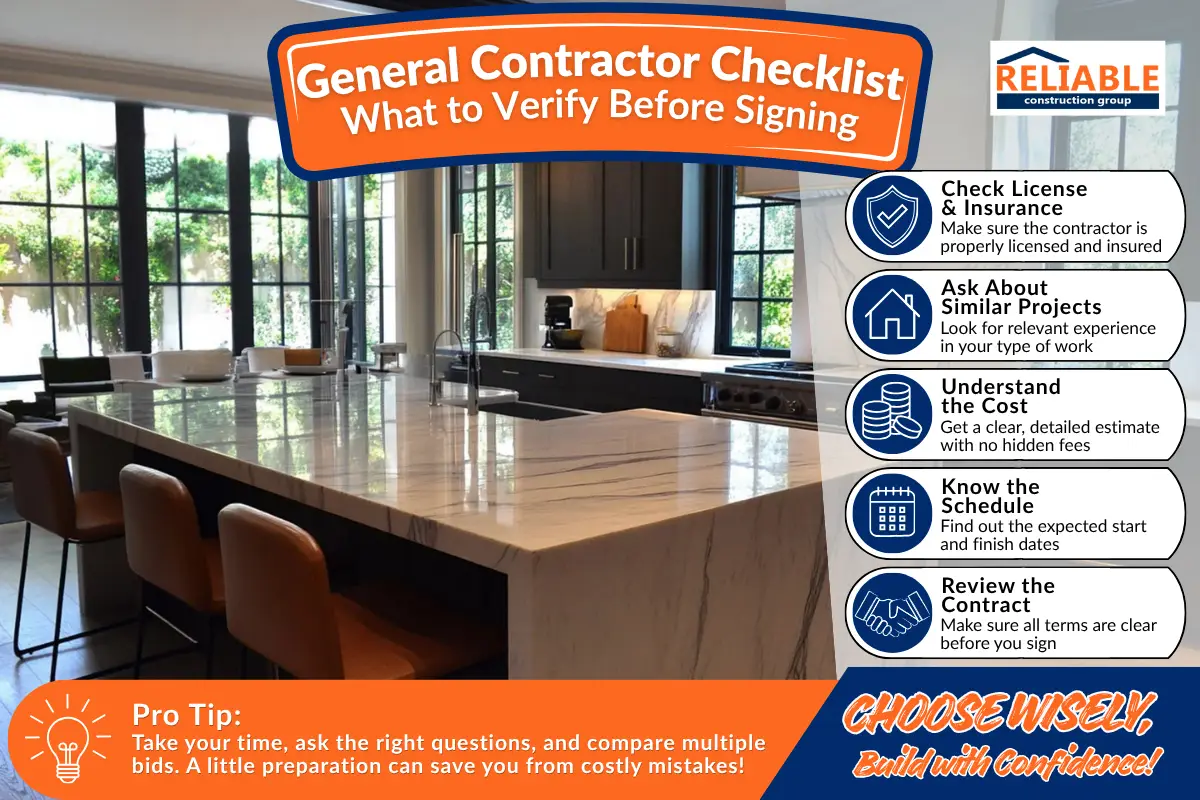
Jaspector says a strong proposal usually covers scope, materials, exclusions, allowances, schedule assumptions, payment terms, and warranty language. If one is missing, ask for it in writing.
What is an allowance in a contractor estimate?
An allowance is a budget placeholder for items you have not selected yet, such as tile or lighting. It is not a final price, and low ones can lead to change orders, according to BuildZoom.
What is an exclusion?
An exclusion is something not included in the price, such as permits, debris removal, or engineering. ProConstruction says exclusions appear frequently in lower bids and become costly change orders, so price them separately before comparing totals.
Is the lowest estimate usually the best?
Not automatically. The FTC says not to pick the lowest bid without asking why prices differ. A low bid might reflect a smaller scope or leaner overhead, or it might reflect missing items, so read the scope, allowances, and exclusions first.
How many estimates should I get?
The FTC says to get written estimates from several firms. Three is a common number, but the key is giving each bidder the same scope so the comparison is fair.
How should payments be scheduled?
Tie payments to finished stages of work, keep any deposit within your state’s rules, and hold back part of the final payment until the work is complete. The FTC and the Arizona Attorney General both warn against large up-front payments.
Final thoughts
Comparing estimates is less about finding the cheapest number and more about finding the clearest one. When scope, allowances, exclusions, and payments sit side by side, the right choice usually stands out, and so do the gaps worth a conversation.
Start with one small step: put your estimates into the worksheet table today and see which rows are blank. Those blanks are your questions for the next call.
Have estimates to compare?
Share your scope and get a clear, itemized estimate that is easy to compare. Detail up front is the best protection against surprises later.