A certificate of occupancy is the document that says a building is legal to live in. It is easy to forget until a lender, a buyer, or an inspector asks for it. Then it becomes the one piece of paper standing between you and moving day.
Here is the rule in model-code terms. A summary of the 2024 International Residential Code from Jaspector says section R110.1 prohibits occupying a newly built or renovated building until the building official issues a certificate of occupancy. Your city may adopt that rule exactly, change it, or call the document something else, so the details always come from your local building department.
This guide explains when you need a certificate of occupancy, how the process usually works, what a temporary version is, and the mistakes that delay it. Sources were checked in November 2026. Rules, fees, and timelines vary by city and state, so use this as a map and confirm each step locally.
Quick answer
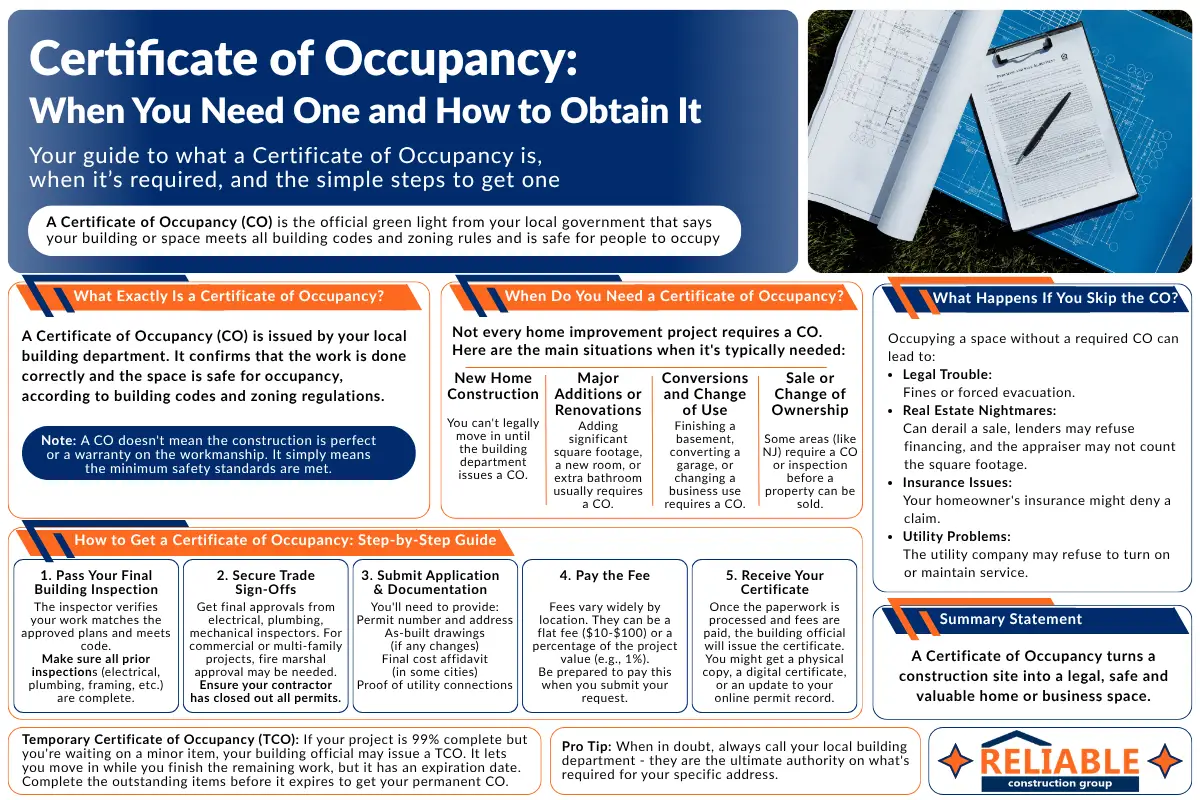
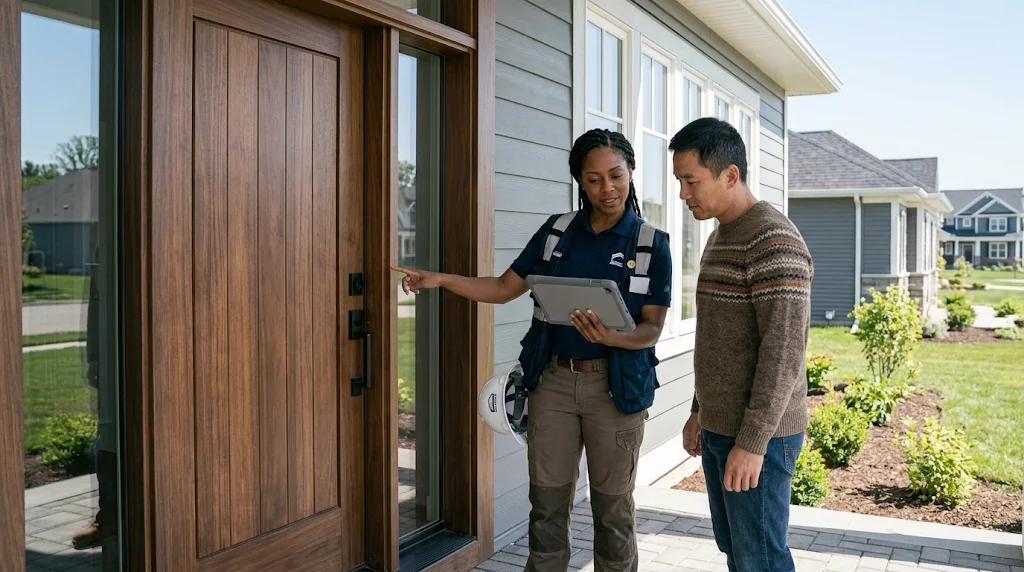
You typically need a certificate of occupancy for new construction, additions, and changes in how a building is used, and in some places for major remodels. You get it by finishing the permitted work, passing the required inspections, submitting any paperwork your city asks for, and receiving the certificate from the building official. Ask your building department early what your project needs, and confirm in writing who is responsible for obtaining it.
What a certificate of occupancy is
Angi describes a certificate of occupancy as a document deeming a living space safe and habitable. It says the building passed a long list of inspections during construction or after major changes, and it may list details such as the building’s occupancy, square footage, zoning information, and applicable codes. A building code training site adds that the building official issues it only after inspecting the building and finding no code violations.
The 2018 IRC summary at Jaspector says section R110.2 directs the building official to issue the certificate after an inspection finds no violations of the code or other laws the official enforces. Put simply, it is the final checkpoint in the permit and inspection system.
When you need one
The common triggers are new construction, additions, and a change in how a building is used. Angi lists several examples: building a new home, turning a garage into a rental apartment, converting a single-family home into a multifamily one, and converting a commercial space to residential. For remodels, the answer depends heavily on where you live.
| Jurisdiction | What it says | Source |
|---|---|---|
| Evanston, IL | Single-family additions, new construction, accessory structures, and some interior remodel permits all require a certificate of occupancy | City knowledge base |
| Canton, CT | A certificate of occupancy for a new building or an addition, and a certificate of completion for renovation or remodel work | Town requirements sheet |
| Moulton, AL | The certificate is issued at final inspection, and you tell the department whether the final is for a certificate of occupancy or a certificate of completion | City building department |
| Keller, TX | For permitted new construction, additions, and remodels, the certificate is issued at completion at no charge | City page |
Model-code language adds a wrinkle. One locally adopted version of the International Building Code, posted on eCode360, exempts one- and two-family homes within the residential code’s scope from the certificate requirement, but says they still cannot be occupied until the building official releases them after all required inspections are approved. In practice, the approval step still stands between you and move-in.
Not every project triggers a certificate. A bathroom refresh or a large-scale kitchen update often ends with a final inspection or a certificate of completion rather than a certificate of occupancy, depending on the town. Turning a basement into living space can be treated differently. Jaspector’s how-to guide notes that a basement remodel may need only a final building inspection in one town, while a garage conversion to living space may need full occupancy approval in another. For an example of that kind of project, see converting a basement into a play space.
Additions are among the clearest cases, since Evanston, Canton, and Keller all list them in the table above. A recent bathroom addition shows the type of project that adds new square footage and goes through final inspections.
How to obtain one, step by step
The process looks similar almost everywhere, even when the forms differ. Jaspector puts it well: you do not get a certificate by filing a clever last-minute request. You get it by completing the work and documentation your permit requires.
- Pull the permits before work starts. Unpermitted work is the biggest obstacle later. Ask the building department which permits and inspections your project needs.
- Schedule inspections at each stage. The City of Sacramento lists typical inspection steps for additions, remodels, and new residences, and notes that other inspections may be required depending on the permit.
- Finish the trade finals. Scituate, Massachusetts asks for final inspections from the electrical, plumbing, fire, and building inspectors, plus a fire department certificate of compliance.
- Request the final building inspection. The inspector compares the finished work with the approved plans and code.
- Submit the certificate application and any paperwork. Some cities issue it at the final inspection, and others require a separate application.
- Receive and keep the certificate. Store a copy with your closing, insurance, and permit records.
Who handles all of this? Angi says the general contractor usually obtains the certificate on new construction or a major renovation, while owners, sellers, or landlords handle it in other situations. Confirm that in writing before you sign. For more on how local building departments work, see the towns a contractor serves and ask your contractor which departments they deal with regularly.
Temporary certificates of occupancy
A temporary certificate of occupancy, often called a TCO, allows occupancy before every item is finished. Ontario, California says its building department may issue a TCO that lets a portion or all of a building be occupied before all construction is complete, and that it requires a written request and a deposit that is forfeited if the final certificate is not obtained by the agreed date. Missaukee County, Michigan describes a 30 to 90 day window for finishing minor items before a final inspection. Angi cites New York City, where a TCO requires fixing outstanding safety issues within 90 days.
Evanston, IL gives a concrete example. Its knowledge base says a TCO is allowed for phased occupancy and for items that cannot be finished because of weather, such as final grading or concrete and asphalt installation. A separate application is needed for the final certificate. Rules differ widely, and some places do not issue TCOs for houses at all, so ask.
Paperwork cities ask for
The paperwork list depends on the city and the project. These three examples show the range.
| Place | Examples of what it asks for |
|---|---|
| Evanston, IL (temporary) | Final inspection reports for structural, plumbing, HVAC, electrical, and fire, plus health department and water district approvals where applicable |
| Evanston, IL (final) | A notarized sworn statement of final construction cost, final approved plans in PDF, a final plat of survey with grades for larger excavations, and an accessibility door-force self-certification |
| Scituate, MA | An as-built foundation plan for new construction and additions, final inspections from each trade, and a fire department certificate of compliance |
| Greene County, GA | A final inspection letter from the health department on the septic system where applicable, per its permit application |
Keep copies of every inspection report and sign-off. Jaspector’s guide suggests keeping a log of every inspection called, approved, and rejected, since the building official reviews the full inspection history when the final is called.
Timeline and cost
Processing times vary. Evanston says a temporary certificate can be issued within about 5 days of a complete application, and a final certificate can take up to 30 days. Cranford, New Jersey tells owners selling a new home immediately after construction to allow at least three weeks after the final inspections for zoning and engineering approvals.
Example (our arithmetic): if your closing is June 30 and your town needs three weeks after the final inspections, schedule the finals by June 9. Allow extra days for a failed inspection and reinspection.
Costs also vary. Angi says the cost depends on where you live and the building department’s process, and that the property type and square footage can matter. I found no reliable national figure. Keller, TX lists a $50 cost for a certificate of occupancy application, and no charge when the certificate is issued at the completion of permitted new construction, an addition, or a remodel. Ask your building department for its fee schedule.
If you fail inspection or have no certificate
A failed inspection is normal and fixable. Angi says that if an inspection requires fixes, the inspection has to be repeated when the work is complete. Read the correction list, fix every item, and book the reinspection.
Occupying too early is riskier. Murray County, Georgia’s policy says that if a structure is occupied at final inspection, the building official may post a notice giving at most 48 hours to remove the people or materials. Jaspector’s IRC summary notes that a revoked certificate triggers the same ban on occupancy as if none had been issued. Penalties differ by place, so check yours.
If an existing home or addition has no certificate on file, you are not out of options. iPropertyManagement says many owners obtain a certificate retroactively, and that your local building department can outline the steps. Expect inspections, and possibly corrections, before it is issued. A local attorney or experienced contractor can advise on how your city treats older unpermitted work.
Lenders care too. Angi says a mortgage company typically requires the certificate on new construction to approve a loan for the final payment to the construction team. For existing homes, not every area requires one for a standard purchase, so ask your agent or closing attorney.
General information, not advice
This article is general information and not legal or financial advice. Certificate rules, penalties, and fees vary by city and state. Confirm requirements with your local building department, and ask a licensed attorney about any legal exposure from occupying a building without one.
Four traps that delay occupancy
Moving in early. After months of waiting, handing over the keys feels like the finish line. It is not. Hold the move until the certificate or release is in hand, and keep boxes and furniture out until then.
The “while we’re at it” change. An extra window, a moved wall, or a finished attic added after the permit is issued does not match the approved plans. Angi says the inspection checks that the final construction matches the plans submitted for the permit. Jaspector warns about scope drift, such as a finished basement becoming a bedroom before final inspection. Revise the permit before you change the work.
Assuming someone else has it. Angi says the contractor usually obtains the certificate, but “usually” is not a contract term. Put the responsibility, the inspection schedule, and the application in writing.
Optimism about the schedule. Timelines often assume nothing fails and no office is backed up. Build in extra weeks between the final inspection and your move or closing date, as the Cranford guidance suggests.
Your certificate of occupancy checklist
- ☐I asked the building department whether my project needs a certificate of occupancy, a certificate of completion, or only a final inspection.
- ☐All permits were pulled before work started, and none are expired or open.
- ☐Every trade final (electrical, plumbing, mechanical, fire) is passed and documented.
- ☐The work matches the approved plans, or the permit was revised for any changes.
- ☐I know whether my city allows temporary certificates and what they require.
- ☐The contract says who applies for and pays for the certificate.
- ☐I have the application, fee schedule, and processing time in writing.
- ☐My move or closing date leaves a buffer after the final inspection.
- ☐I will keep a copy of the certificate with my permit and closing records.

FAQ
What is a certificate of occupancy?
It is a document issued by the building official saying a building passed the required inspections and is safe to occupy. Angi describes it as deeming a living space safe and habitable.
Do I need a certificate of occupancy for a remodel?
It depends on the town. Evanston, IL requires one for some interior remodels, Canton, CT uses a certificate of completion for remodels, and Keller, TX issues one at completion of permitted remodels. Call your building department.
What is a temporary certificate of occupancy?
It allows occupancy before all work is finished, usually with conditions and a deadline. Ontario, CA requires a written request and a deposit, and Missaukee County, MI describes a 30 to 90 day window for minor items.
How long does it take to get a certificate of occupancy?
It varies. Evanston, IL cites about 5 days for a temporary certificate and up to 30 days for a final one, and Cranford, NJ tells sellers to allow at least three weeks after final inspections.
How much does a certificate of occupancy cost?
There is no reliable national figure. Keller, TX lists a $50 cost for a certificate of occupancy application and no charge when it is issued at completion of permitted new work. Ask your building department for its fee schedule.
Can I live in a house without a certificate of occupancy?
Generally no. The IRC model code bars occupancy until the building official issues one, and some places can post a notice ordering occupants out. Check your local rules and ask an attorney if you are in this situation.
Final thoughts
The certificate of occupancy is the last gate on a project, and most delays come from small, avoidable gaps: a missing sign-off, a change that never reached the permit, or a closing date set with no buffer. None of them is hard to fix if you see them early.
Start with one small step this week: call or visit your building department’s website and ask exactly what your project needs. Then put the answer, and who is responsible for it, into your contract.
Building, adding on, or finishing a space?
Ask your contractor who will handle inspections and the certificate of occupancy before you sign. A written scope and schedule keep the finish line from becoming a surprise.