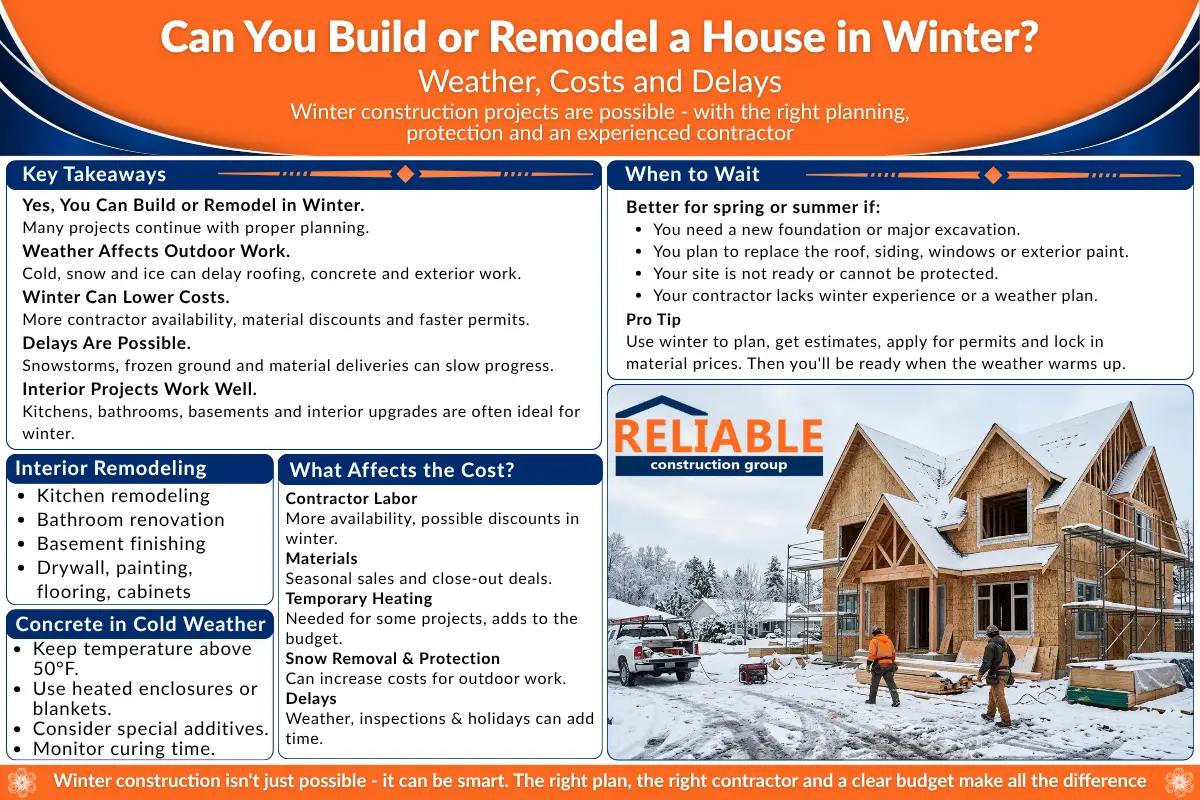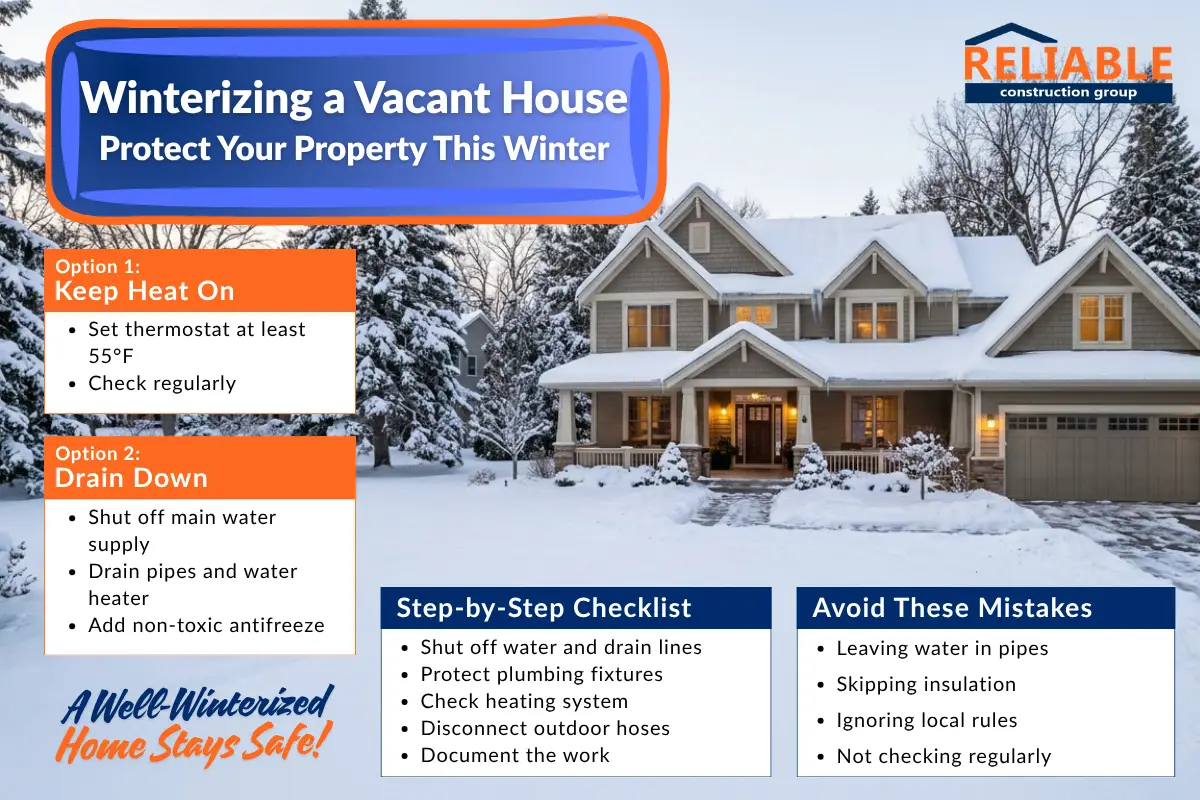
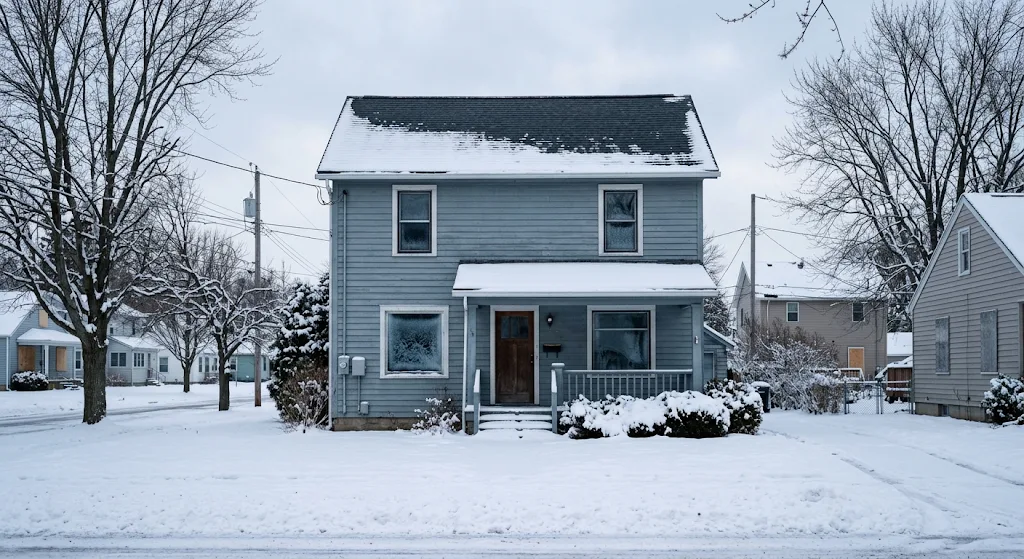
A vacant house is quiet until the first hard freeze. Then a single pipe can split, run for days with nobody home, and turn a sound property into a water-damage claim. If you own, manage, or service an empty house, winterizing is one of the few jobs that is cheap compared with what it prevents.
Property preservation rules treat this as routine work, not an extra. Fannie Mae says servicers must preserve both the interior and exterior of vacant properties securing delinquent loans year-round, regardless of loss mitigation status. Winterizing is often part of that work, and your obligations depend on who is responsible for the property.
This guide explains what winterizing means, the two basic approaches, the general steps, how to document the work, and where servicer, investor, insurer, and local rules come in. Sources were checked in November 2026. Requirements differ by servicer, investor, insurer, and city, so confirm yours in writing before you act. This article is general information, not a replacement for your instructions.
Quick answer
To winterize a vacant house, you either keep the heat on at a safe level or shut off and drain the water and heating systems so nothing can freeze. A typical drain-down means shutting off the water at the main, opening faucets and flushing toilets, draining the water heater, blowing out lines with compressed air where appropriate, adding non-toxic antifreeze to traps, and photographing the work. Servicer, investor, insurer, and local rules differ, so confirm what applies before you start.
What winterizing means
Winterizing protects plumbing and heating systems from freezing damage. Angi describes the core as shutting off the main water valve, draining the pipes, and pouring non-toxic RV antifreeze into toilets and drains so leftover water cannot freeze. This Old House adds that you should drain the water heater, insulate exposed pipes, and disconnect and drain outdoor hoses and sprinkler systems.
The goal is simple: no standing water anywhere it can freeze, and no unattended system that can fail. How you reach that goal depends on the house, the climate, and the rules that apply to the property.
Two approaches: keep heat on or drain down
The first approach keeps the heat running at a minimum level. An older HUD preservation attachment, hosted by the property preservation company Safeguard Properties and labeled 2009, said that in states where heat was to remain on, the temperature should be maintained at 55 degrees Fahrenheit. Insurance commentary uses a similar benchmark. A PropertyCasualty360 coverage Q&A says heat is generally considered maintained above 55 degrees. If you keep heat on, you also need working utilities, fuel, and regular inspections.
The second approach is a drain-down: shut off the water and drain everything so there is nothing left to freeze. It works when the heat will be off, but it also means every fixture and appliance has to be handled correctly.
| Approach | How it works | Main risk |
|---|---|---|
| Keep heat on | Maintain a minimum temperature and keep utilities active | Power or fuel failure, or a furnace breakdown, can still freeze pipes |
| Drain down | Shut off water, drain systems, add antifreeze to traps | Missed fixtures or appliances can still hold water |
Servicers and investors often specify which approach to use. Ask first, because the wrong choice can cost you a claim or a reimbursement.
Winterizing steps, in order
These are general steps for a typical home with a forced-air heating system. They draw on consumer and utility guidance, plus structure from older HUD instructions. Your servicer, investor, or insurer may add or change steps.
- Get instructions in writing. Confirm who is responsible, which approach applies, and what documentation is required.
- Inspect and photograph first. The older HUD attachment required before and after photographs, along with other supporting documents, to support a reimbursement claim.
- Shut off the water supply. Turn off the main valve. This Old House and Angi both start here. A water authority guide warns that a water meter is not a shutoff valve and should never be used as one.
- Check for fire sprinklers. Vacasa advises not turning off water to a fire sprinkler system. If one is present, handle it separately and get professional guidance.
- Drain the lines. Open all faucets, hot and cold, and flush toilets until tanks and bowls are empty. This Old House suggests using an air compressor to blow out remaining water. The older HUD attachment said faucets and valves should stay open during draining and be closed afterward.
- Drain the water heater. Shut off its power or gas first, then drain it. American Home Shield says to drain the water heater if you plan to shut it off, and to drain the pressure tank if the home has a well.
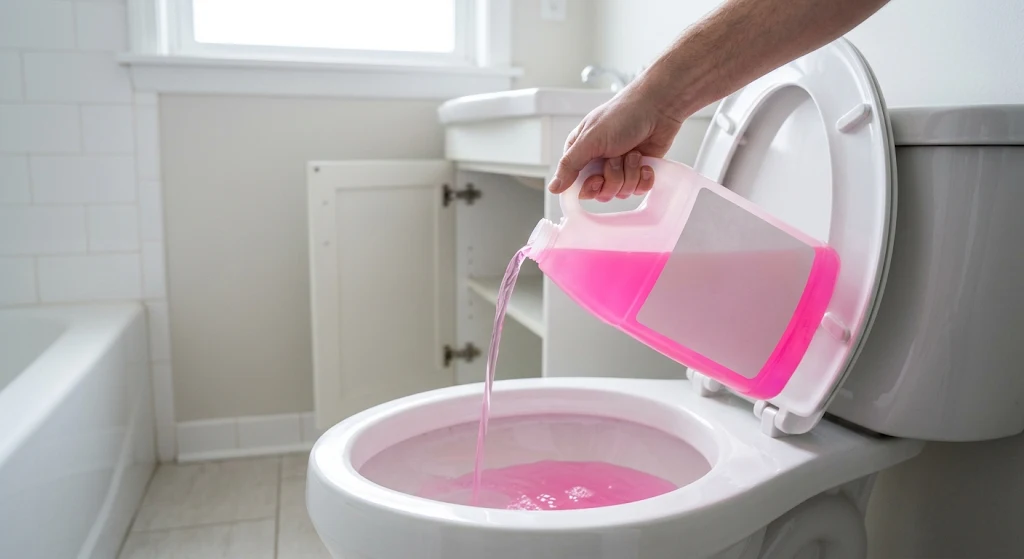
- Add non-toxic antifreeze. Put it in toilet bowls, sink traps, and tub and shower traps. The older HUD attachment called for adequate antifreeze in all fixture traps, including toilet tanks and bowls.
- Handle appliances and outdoor lines. A consumer winterizing checklist includes washing machines, dishwashers, ice makers, and outdoor faucets, and This Old House says to disconnect and drain outdoor hoses and sprinkler systems. Follow each manufacturer’s instructions.
- Insulate and seal. Wrap exposed pipes in unheated areas with foam or fiberglass insulation, as AHS suggests.
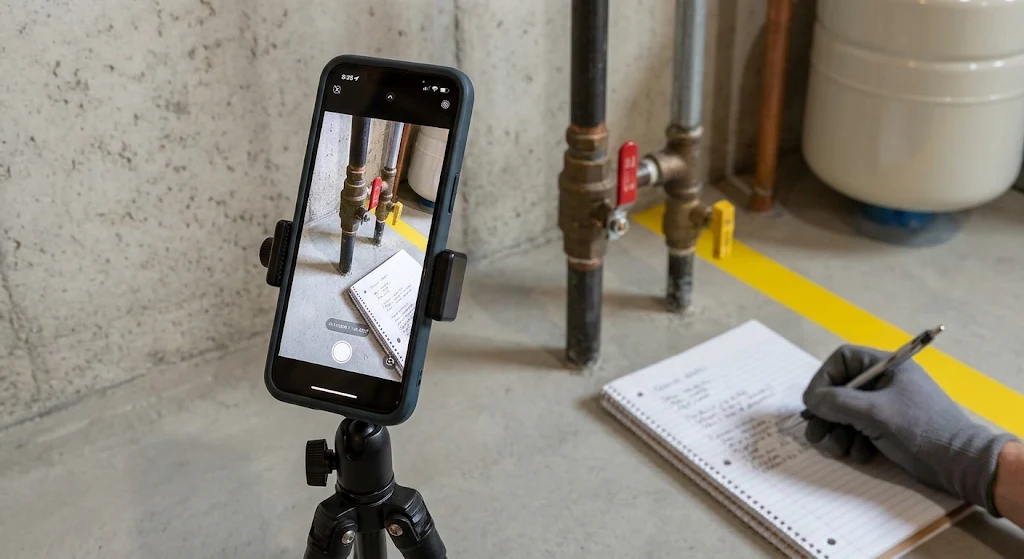
- Photograph the finished work. Capture shutoff valves, drained fixtures, and antifreeze placement, then store the photos with the date.
Small first step
Before you touch a valve, take a photo of the main shutoff and of the thermostat. Those two photos will save time later and help if a claim or a dispute arises.
Heating systems need extra care
A forced-air system is the simple case. Boilers, radiant heat, and steam systems hold water of their own and need extra steps. The older HUD attachment separated these systems for that reason. It said boiler systems must be drained, radiator vents opened, and radiant piping blown dry and filled with antifreeze, and it warned that bleeder pins on radiators should not be removed.
Steam systems are different again. The same HUD attachment said it was important to determine whether a system is hot water or steam before acting, because the wrong action can damage it. If you are not sure which system a property has, have a qualified heating contractor handle it.
Other systems matter too. The older HUD attachment said that where a sump pump is used to keep a basement or crawl space dry, the electricity should be left on, even where other utilities are shut off. If gas is involved, Vacasa advises calling your service provider to shut it off rather than doing it yourself.
Whose rules apply
Several sets of rules can apply to the same house, and they do not always match. Here is how to think about each.
| Who | What to know | Source |
|---|---|---|
| Fannie Mae servicers | Servicers must preserve the interior and exterior of vacant properties securing delinquent loans year-round | Fannie Mae property preservation page |
| Fannie Mae details | Preservation work follows the Property Preservation Matrix and Reference Guide | Servicing Guide F-1-08 |
| FHA servicers | HUD Handbook 4000.1 is the authoritative source for FHA single family policy | HUD handbook overview |
| HUD liability | HUD has said it will hold a mortgagee liable for damage to a vacant or abandoned property caused by failure to preserve and protect it | HUD Mortgagee Letter 10-18 |
| Freddie Mac servicers | Winterization appears as its own expense category in the Guide’s approved expense exhibit | Freddie Mac Exhibit 57 |
| Local government | Cities may require vacant property registration or maintenance; Fannie Mae’s older matrix lists registration at actual cost per local requirement | Fannie Mae pricing rules |
A servicer-facing resource, Property Vendors, says the primary source for FHA preservation and protection policies, including winterization, is Handbook 4000.1, and it recommends checking the official servicing guides for HUD, VA, Fannie Mae, and Freddie Mac. It also says those documents list any currently approved state-level variances. That is good advice for anyone acting for a servicer.
Regional rules can differ even inside one program. The older HUD attachment listed local variations, including one for Illinois and Indiana that called for winterizing year-round and keeping heat off unless a sump pump required power. That document is old and may not match current policy, so treat it as an example of how local variation works, not as today’s rule.
If you are in the Chicago area, foreclosure services in the Chicago area and the areas covered show how a local contractor describes its work. Always ask which servicer or investor instructions apply before any work begins.
Insurance and vacancy
Insurance can turn a freeze into a denied claim. Adjusters International explains that in a standard HO-3 policy, coverage for glass breakage and vandalism ends if the dwelling has been vacant for more than 60 consecutive days before the loss. It adds that some earlier homeowners forms said the exclusion for freezing applied while the dwelling was vacant, unless the insured had maintained heat or shut off the water supply. A PropertyCasualty360 discussion quotes frozen-plumbing exclusion language of that kind: you do your best to maintain heat, or you drain the equipment and shut off the supply if the heat is not maintained.
Policy language varies, and the details decide a claim. Adjusters International also describes a vacancy permit endorsement as the recourse for a property that will be vacant longer than the policy allows. Call your insurance agent before the property sits empty, and ask three questions: what counts as vacant, what is excluded and when, and what proof you need to show that the property was winterized.
What it costs
I found no reliable current national figure for the cost of winterizing a vacant house. Prices depend on the size of the home, the type of heating system, the region, and who is paying. Servicers and investors also set their own allowable amounts in their guides, and those change, so do not rely on old fee schedules.
Instead of a number, ask for an itemized quote. Useful lines include labor, antifreeze and supplies, compressed air work, any boiler or radiant system work, water shutoff by the utility, photos and reporting, and the cost of de-winterizing later. Comparing line items makes it easier to see why two quotes differ.
Four mistakes that cause damage
Waiting for the first freeze. Optimism about the weather is the most common trap. Plan the work before cold weather arrives, since a cold snap can come quickly and crews get busy.
Assuming the job is done once the water is off. Traps, toilet tanks, appliances, and heating systems can still hold water. The older HUD attachment also said a property should be re-winterized if the first winterization is violated, which means someone opened the system or it failed.
The “while we’re at it” repair. Once a house is drained, any plumbing or renovation work means re-opening the system. If you plan kitchen updates, bathroom updates, or basement work, coordinate the schedule so you are not winterizing and de-winterizing repeatedly. Project examples show the kind of work that often follows once a property is back in service.
Skipping documentation. A job without photos is hard to defend later. Take dated before and after photos of valves, fixtures, and the heating system, and keep them with your notes.
Winterizing checklist
- ☐I have written instructions from the servicer, investor, or owner on which approach applies.
- ☐I confirmed what the insurance policy requires for a vacant property.
- ☐I took dated photos of the shutoff valves and thermostat before starting.
- ☐The main water supply is off, and I did not use the meter as a shutoff valve.
- ☐Fire sprinklers, wells, and sump pumps were handled separately and correctly.
- ☐All lines were drained, toilets flushed, and the water heater drained.
- ☐Non-toxic antifreeze is in every trap, toilet bowl, and tank that needs it.
- ☐Boilers, radiant, or steam systems were handled by a qualified contractor.
- ☐Appliances and outdoor lines are drained, and exposed pipes are insulated.
- ☐I photographed the finished work and saved the records.
- ☐I checked local vacant property registration or maintenance rules.
General information, not advice
This article is general information and not legal, insurance, or engineering advice. Servicer, investor, insurer, and local requirements differ and change. Confirm the instructions that apply to your property, follow state and local codes, and use a licensed professional for plumbing and heating work.
FAQ
What does it mean to winterize a vacant house?
It means protecting the plumbing and heating systems from freezing. You either keep the heat on at a safe temperature or shut off and drain the water systems, add non-toxic antifreeze to traps, and document the work.
Should I leave the heat on in a vacant house?
It depends on the rules for your property and your insurance. The older HUD attachment used a 55-degree minimum where heat was to remain on, and an insurance coverage commentary says heat is generally considered maintained above 55 degrees. Confirm what your servicer and insurer require.
Is it safe to use regular antifreeze?
Angi and This Old House both describe non-toxic antifreeze, such as the RV type, for toilets and drains. Check the product label for plumbing use, and follow your servicer’s or investor’s specifications if they name a product.
Who is responsible for winterizing a foreclosed property?
It depends on who holds the property and the loan type. Fannie Mae says servicers must preserve vacant properties securing delinquent loans, and HUD has said it can hold mortgagees liable for damage from failure to preserve. Ask the servicer or investor for instructions.
How much does winterizing cost?
There is no reliable national figure. Prices vary with house size, heating type, region, and who is paying, and servicer allowable amounts change. Ask for an itemized quote.
When should I winterize?
Before freezing weather arrives. The older HUD attachment said winterization should be done October 1 to March 31 where required, with local variations, but current dates depend on the servicer, investor, and climate. Confirm your dates.
Final thoughts
Winterizing is a small job with a large upside. Decide who is responsible, choose the right approach, drain and protect every system, and keep photos. The details change by servicer, investor, insurer, and city, which is why the first step is always to ask.
Take one small step this week: write down who is responsible for the property, which rules apply, and when your freeze risk begins. Then schedule the work before the cold arrives.
Need help with a vacant property?
If you manage vacant or foreclosed properties, tell us what you need. Servicer and investor requirements differ, so bring your instructions with you.
Talk to us about property preservationLearn about foreclosure services