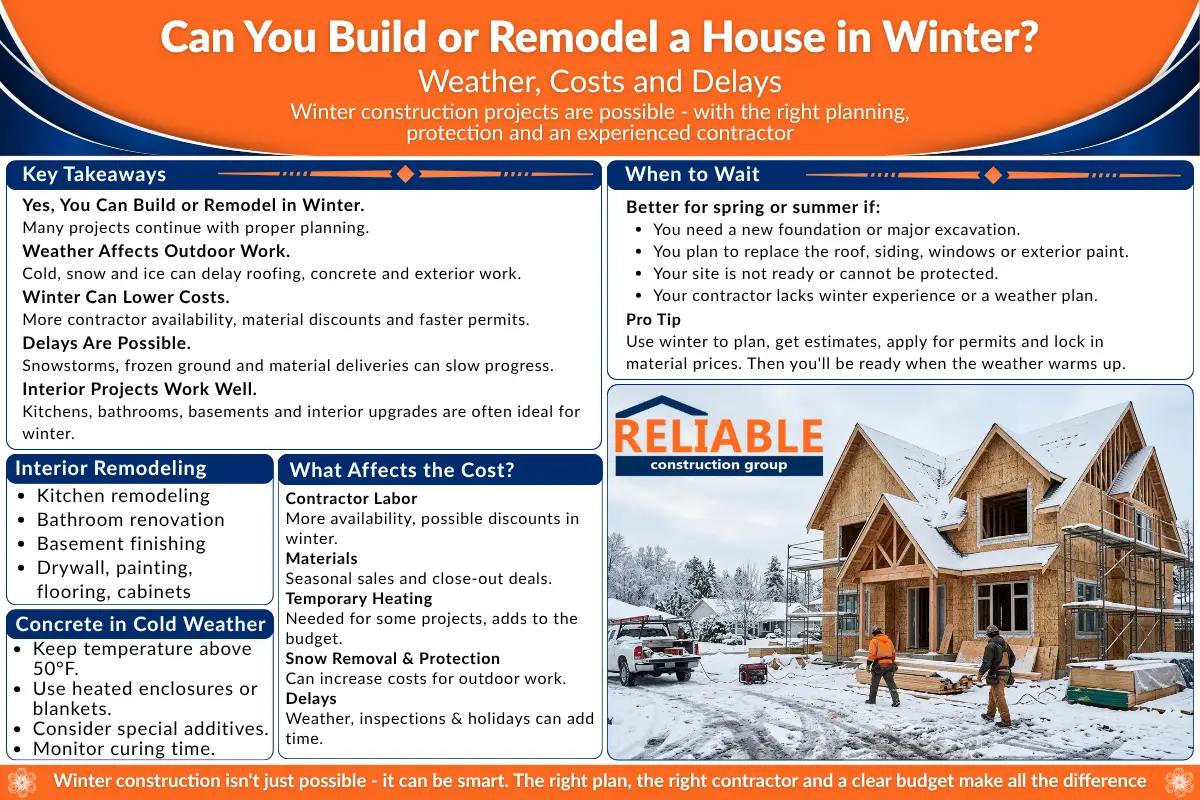
The first hard freeze arrives, and your project list does not care. Maybe you are halfway through planning an addition, or you want the kitchen done before spring. Can anything actually get built when the ground is frozen and the days are short? The honest answer is yes, with limits that depend on the type of work.
One number keeps appearing across trades: 40°F. The Portland Cement Association says special concrete precautions apply whenever air temperature at placement is below 40°F and freezing is expected within the first 24 hours. Owens Corning’s cold-weather shingle bulletin uses the same threshold, and drywall guidance sets 40°F and 50°F lines of its own. Learn those thresholds and winter planning becomes much easier.
This guide covers which winter construction projects work best, where cold weather adds cost or delay, and what to ask your contractor. Sources were checked in November 2026. Climate, local codes, and contractor practices vary, so treat the numbers as starting points for your own conversation.
Quick answer
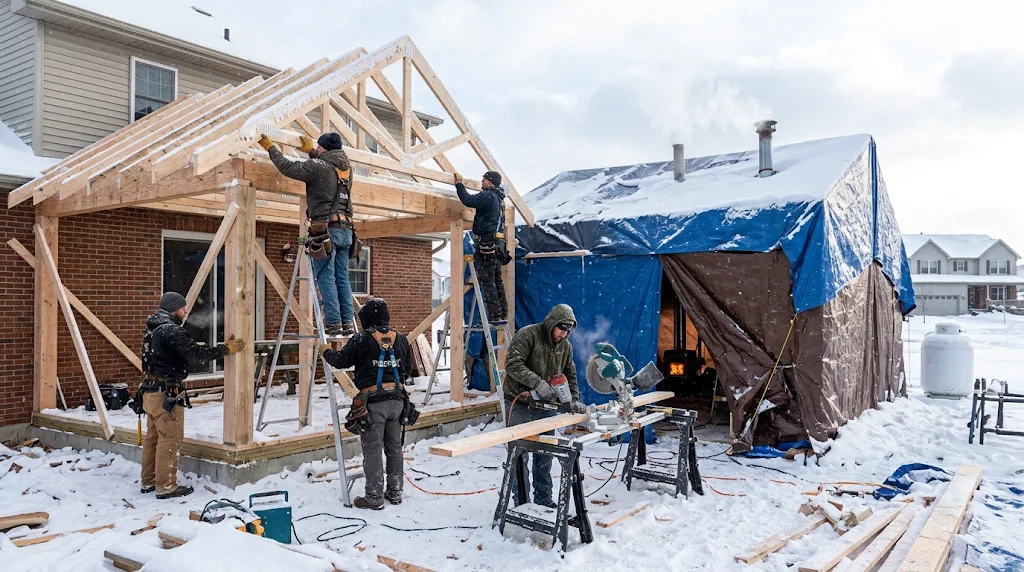
Yes, you can build or remodel in winter. Interior remodeling is the easiest winter work. Foundations, roofing, and exterior work can proceed, but they need cold-weather methods that raise cost and add risk of delay. Plan around the temperature thresholds, budget for temporary heat and protection, and add buffer weeks for snow and short days.
Which winter projects work best
The type of project matters more than the date. Angi says remodeling a basement or interior rooms can be easier to hire for, and sometimes cheaper, in winter, since contractors are busier in warmer weather. It also warns against projects that remove windows or tear out exterior walls in winter, since you would be exposing the inside of your home to the cold, and notes that icy roofs are a safety risk for crews.
| Project type | Winter outlook | Why |
|---|---|---|
| Kitchen, bath, and basement remodeling | Usually a good fit | Work stays indoors, and weather rarely stops it |
| Interior finishing: cabinets, trim, tile | Good, with heat | Needs a heated space for materials and finishes |
| Foundations and concrete | Possible, with extra protection | Cold-weather methods raise cost and complexity |
| Roofing | Possible, with care | Shingles can crack and may not seal until it warms up |
| Window replacement and exterior wall openings | Usually best avoided | Opens the house to the cold |
| Exterior painting and finishes | Often better in warmer weather | Paint and some other materials may not cure properly in the cold |
Block Renovation adds the regional caveat: homeowners in the Midwest or Northeast may face significant weather barriers in late fall and winter. Contractors, on the other hand, tend to have more availability because many homeowners put renovations off in the colder months. A KVIA report makes the same point, noting that contractors turn to winter projects like basement finishing and interior updates.
The temperature thresholds that matter
| Material or trade | Threshold | What it means | Source |
|---|---|---|---|
| Concrete | 40°F | Cold-weather methods apply when air temperature is at or expected to fall below 40°F during the protection period | ACI 306R-16 via Kryton |
| Drywall installation | 40°F | Room temperature kept at not less than 40°F for mechanical installation | CertainTeed |
| Drywall finishing | 50°F | Not less than 50°F for adhesive, joint treatment, texturing, and decoration | CertainTeed |
| Joint compound | 50°F for 48 hours | Kept at 50°F or above for 48 hours before, and continuously until materials are dry | Gypsum Association GA-236 |
| Asphalt shingles | 40°F | Extra care and cold-weather procedures at or below 40°F | Owens Corning |
Those thresholds explain most winter surprises. A schedule that works in October can stall in January because a trade needs a warmer room than the one you have.
Concrete and foundations
Concrete can be placed in winter, but only with a plan. The Portland Cement Association says that concrete as placed should be above 40°F, and that duration of heating depends on how the concrete will be used. It also notes that indirect-fired heaters should be used to avoid carbonating fresh concrete surfaces. Kryton says unprotected concrete can freeze, especially at exposed corners, and gains strength much more slowly, and that water curing is not recommended when freezing temperatures are possible.
Those precautions cost money. A ForConstructionPros article summarizing ACI guidance says heated enclosures, insulating blankets, and ground-thawing equipment increase both project costs and operational complexity. Kryton frames the question every owner should ask before a winter pour: is it economical and possible to follow the guidelines, or can the schedule wait?
A pour that cannot wait versus one that can
If a foundation or slab can safely wait for milder weather without delaying everything else, ask your builder what the savings and risk look like both ways. If it cannot wait, ask to see the cold-weather concrete plan in writing before the pour.
Interior work and temporary heat
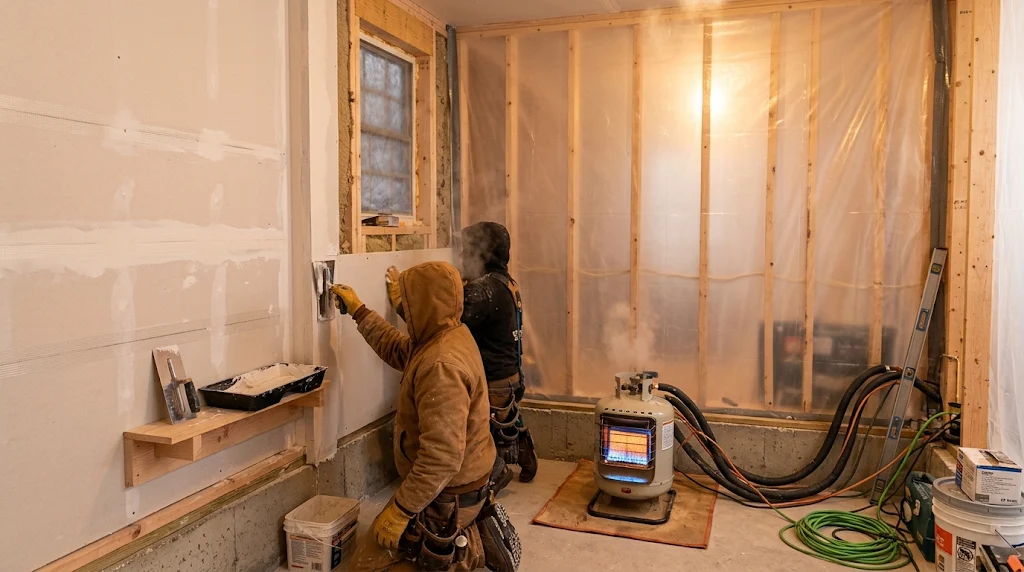
Interior work is where winter helps most, but heat still matters. The Gypsum Association’s guidance says joint treatment should not be applied to cold or damp surfaces, that room temperature should stay at 50°F or above for 48 hours before and during finishing until materials are dry, and that a temporary heat source should not exceed 95°F. It also advises protecting ready-mixed joint compound from freezing and using setting-type compounds to avoid many cold-weather problems.
Temperature is only part of the story. Green Building Advisor points out that a building can be warm enough for drywall finishing while the air holds so much moisture that joint compound takes much longer to dry. Ask whether your contractor plans to dehumidify or ventilate, not just heat.
Winter also changes your utility bill. Turnkey Renovations, a Calgary company, says opening interior walls or insulation lets heated air escape more easily, so temporary heating and sealing should be built into the budget. If you are planning an indoor basement upgrade, an indoor kitchen project, or an indoor bathroom project, ask who pays for temporary heat and who supplies it.
Examples of finished interior work can help you picture the scope. Look at a finished lower level in Wheaton, a playroom built below grade, and a guest bathroom renovation in Schaumburg, and ask your contractor how each would be handled in cold weather.
Roofing and exterior work
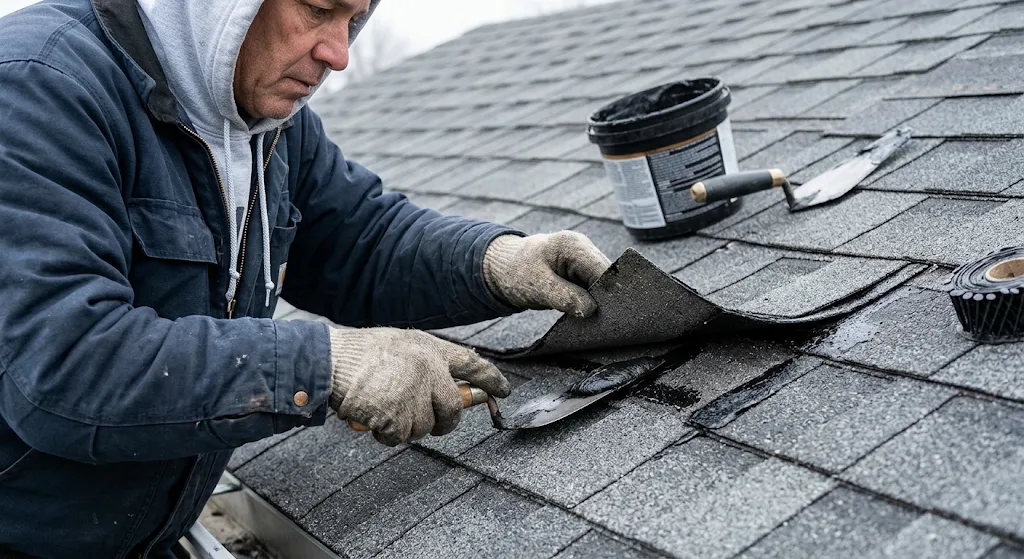
Asphalt shingles are the best-documented example. The Asphalt Roofing Manufacturers Association’s cold-weather recommendations say to follow manufacturers’ instructions, avoid bending, throwing, or dropping bundles, and consider hand-sealing in very cold weather with approved roofing cement. Most shingles use a thermally activated sealant, and in cold conditions the bond may be less flexible. Owens Corning says shingles installed in cold weather may not seal right away and may take longer to lay flat.
GAF says hand-sealing is most common on very steep slopes, in high-wind areas, and during cold-weather installations. One manufacturer, Malarkey, says its wind warranty applies only when shingles are sealed, either by hand or by self-sealing strips. A roofing company, Statewide Roofing Specialist, says hand-sealing can add 20% to 30% to labor time. That is one contractor’s figure, not a national standard.
Example (our arithmetic, an estimate): if the labor line on your roofing quote is $6,000, a 20% to 30% increase adds $1,200 to $1,800. Ask whether the quote already includes hand-sealing, and whether it is priced separately.
Costs: possible savings and extra charges
Winter can cut some costs and add others. The table separates the two.
| Possible savings | Possible extra charges |
|---|---|
| Contractors may have more availability and may offer competitive pricing (Block Renovation) | Temporary heating, protective coverings, and storage (Turnkey Renovations) |
| Contractors busier in warmer weather may charge less in winter (Angi) | Cold-weather concrete protection: heated enclosures, blankets, ground thawing (ForConstructionPros) |
| Suppliers may offer off-season pricing (Baeumler Approved) | Hand-sealing shingles, which one roofing company says adds 20% to 30% to labor |
Baeumler Approved, a Canadian contractor network, says suppliers may offer off-season pricing. Angi suggests contacting a contractor in late summer or early fall to get on the winter schedule. I found no reliable national figure for how much winter pricing differs, and savings depend on your market and the trade. Ask for written line items so you can see whether a discount is real.
Planning ahead also helps. For projects that need a local crew, check local crews in your area early so you can book before the calendar fills.
Delays and scheduling
Weather delays are the main winter risk. Turnkey Renovations says snow, ice, and extreme cold can delay both exterior and interior work, and that reduced daylight shortens the working day. It recommends building buffer time into the schedule for snowstorms, freezing conditions, and limited daylight. The KVIA report lists shorter daylight hours and inclement weather among the seasonal factors that affect productivity.
Timelines vary widely even without weather. NAHB’s analysis of Census data found that a new single-family home took 8.8 months on average in 2025 from permit to completion, with New England averaging 13.5 months and the South Atlantic 7.6. Those numbers cover all seasons and regions, so do not read them as a winter penalty, but they show how much local conditions matter.
Site access matters too. Turnkey Renovations suggests keeping pathways clear of ice and snow, and protecting floors and furnishings against cold-related damage. Ask who handles snow removal and site protection, and write it into the contract.
Questions to ask your contractor
- What is your cold-weather plan for concrete, and can I see it in writing?
- How will the work area be heated and dried, and who pays for temporary heat?
- Will you hand-seal shingles, and is that included in the price?
- How do you handle weather days in the schedule and the contract?
- What winter conditions would make you pause work?
- How will you protect open walls and the rest of the house from cold?
- Are permits and inspections scheduled with winter in mind?
- Does the price include winter-specific items, or would they come as change orders?
Four traps of winter planning
Optimism about the schedule. A plan that assumes no snow days looks good until the first storm. Add buffer weeks, and ask the contractor to show how weather is treated in the timeline.
Anchoring on the winter discount. A lower price is appealing, but extra costs for heat, protection, and sealing can eat into it. Compare itemized totals, not headlines.
The “while we’re at it” change. Winter is a poor time to decide to open an exterior wall or move a window, since it exposes the house to the cold. Settle exterior changes before work starts, or save them for spring.
Sunk cost and the booked crew. After a crew is booked, it is tempting to pour or roof in bad conditions to keep the date. Kryton’s question applies: can the schedule wait? A delay is usually cheaper than failed work.
Winter project checklist
- ☐I know which parts of my project are interior and which are exterior or structural.
- ☐My contractor gave a written cold-weather plan for concrete and any exterior work.
- ☐The quote shows temporary heat, protection, and hand-sealing as separate lines.
- ☐The schedule includes buffer weeks for snow and short days.
- ☐The contract states who handles heat, dehumidification, snow removal, and site protection.
- ☐Exterior wall or window openings are scheduled for milder weather if possible.
- ☐I confirmed permit and inspection timing with the local building department.
- ☐I booked early, since contractors may need weeks of lead time.
General information, not advice
This article is general information and not engineering advice. Weather limits, material specifications, and local codes vary. Follow the manufacturer’s instructions and local building department requirements for your project, and talk with a licensed contractor or engineer about structural and concrete work.
FAQ
Can you build a house in winter?
Yes, with cold-weather methods. Concrete needs protection when air temperature is at or expected to fall below 40°F, and trades like drywall finishing need heated space. Expect extra cost and a schedule that allows for snow and short days.
Is it cheaper to remodel in winter?
Possibly. Angi and Block Renovation both say contractors may have more availability and may charge less in winter. But temporary heat and protection add costs, and I found no reliable national figure for the difference. Ask for itemized quotes.
What temperature is too cold for concrete?
ACI 306R-16, as summarized by Kryton, treats conditions as cold weather when air temperature is at or expected to fall below 40°F during the protection period. Concrete can still be placed with the right protection and mix design.
What temperature is needed for drywall finishing?
The Gypsum Association says to keep rooms at 50°F or above for 48 hours before finishing and until materials are dry, and CertainTeed lists 50°F for joint treatment. Check your product’s instructions.
Can you replace a roof in winter?
It can be done, but shingles can crack and may not seal until it warms up. Owens Corning and ARMA recommend cold-weather procedures and hand-sealing. Also ask about safety on icy roofs and any warranty conditions.
What is the best time to book a winter project?
Angi suggests contacting a contractor in late summer or early fall to get on the winter schedule. Interior projects are the easiest to schedule in the colder months.
Final thoughts
Winter does not stop construction. It changes the rules. Interior projects often move smoothly, while concrete, roofing, and exterior work need extra protection and extra time. The thresholds are simple once you know them, and so are the questions.
Take one small step this week: split your project into interior, structural, and exterior parts, then ask your contractor which parts they would schedule for winter and which they would hold for spring.
Planning a winter project?
Share your plans and ask how the work would be scheduled in cold weather. A written scope and schedule make winter planning clear.