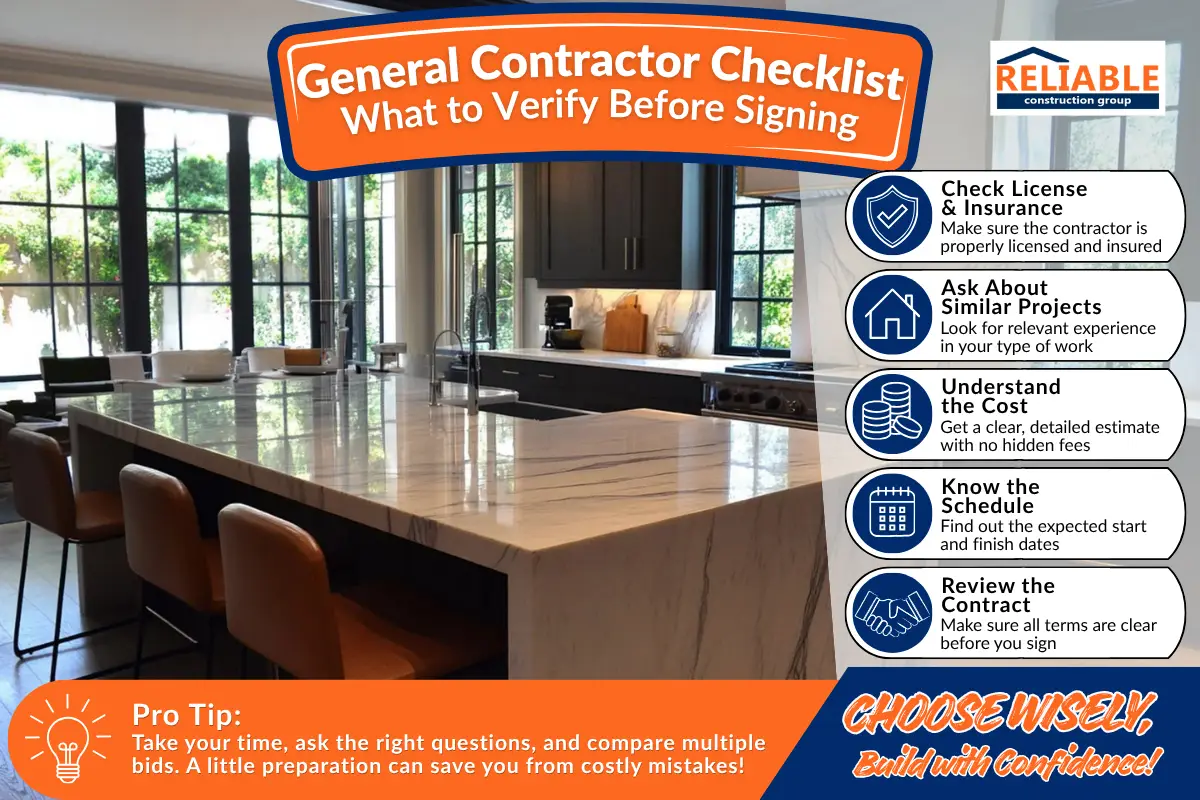
You have three estimates on the table. One is cheaper, one is friendlier, and one has the nicest brochure. Choosing among them feels like a gamble, because you are about to hand a stranger access to your home and a large part of your savings. If you’re wondering how to choose a general contractor, asking the right questions can turn that gamble into a confident decision.
The Federal Trade Commission puts the stakes plainly in its guide, Hiring a Contractor: a home improvement project gone wrong can cost you. The FTC also tells homeowners to get written estimates from several firms and not to pick the lowest bid automatically, since a big price gap deserves an explanation.
This guide gives you 12 questions to ask before signing, why each one matters, and what a good answer sounds like. Sources were checked in November 2026. Licensing, contract, and deposit rules vary by state and city, so confirm the details locally.

Quick answer
Ask about license, insurance, similar projects, references, subcontractors, supervision, schedule, payments, change orders, permits, warranty, and proof that subcontractors and suppliers are paid. Get everything in a written contract, tie payments to completed work, and walk away from anyone who demands cash up front or will not show a license, insurance, or a written contract.
Before you ask: gather written estimates
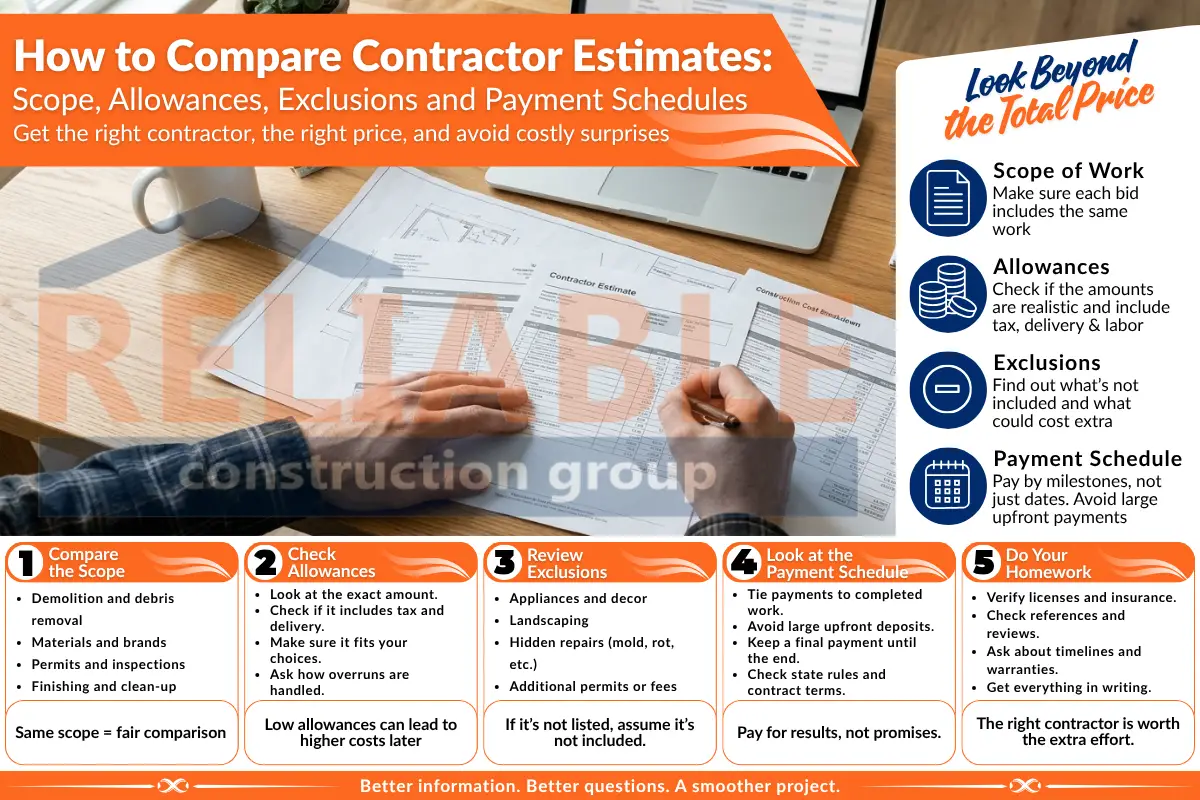
Start with a few written estimates for the same scope. The FTC says to get estimates from several firms and to ask why prices differ, because the lowest price may reflect a thinner scope or cheaper materials. Give each bidder the same plans, material choices, and timeline so you are comparing like with like.
A contractor’s own site should make the basics easy to find. Look for a company background page, portfolio pages that show real jobs, and the areas a contractor lists. If you want a sense of how a contractor presents pricing before a conversation, see a contractor’s pricing page.
The 12 questions
1. Are you licensed, and does my area require it?
Licensing rules differ widely. The Montgomery County, Maryland consumer office suggests checking with your local building department or consumer protection agency to learn what is required, and if your state licenses contractors, asking to see a current license. The FTC says a contract should include the license number if one is required.
Illinois shows how patchy the rules can be. Housecall Pro and Jaspector both report that Illinois has no statewide general contractor license, so general contractors register or license locally, while roofing is licensed statewide through the Illinois Department of Financial and Professional Regulation. Ask your city or county what applies to you.
2. What insurance do you carry, and can I see the certificates?
Ask for copies of current certificates. According to the FTC tips reprinted by Lahaina News, contractors should carry liability, workers’ compensation, and property damage coverage, and without proper coverage you could be held liable for injuries and damages on the job. Kiavi adds that larger projects may call for a surety bond. The FTC says that if a contractor will not provide copies of a license, insurance, or a written contract, that is a red flag.
3. How many projects like mine have you completed in the last year?
This is one of the FTC’s own suggested questions. Ask for a list so you can see how familiar the contractor is with your type of project. A kitchen, a basement, and an addition use different skills and trades. For perspective on how finished projects can look, see a Wheaton basement remodel, a Naperville primary bath, and a luxury kitchen renovation in Northbrook.
4. Can I speak with recent customers and see finished work?
Yes, and ask for more than a phone number. The Gazette suggests asking for two to three references on projects similar to yours, and asking whether you can see the finished work. Dupaco recommends asking past customers about the projected and actual timeline, the final cost, and overall satisfaction. Also ask whether there were costs that were not in the original estimate.

5. Will you use subcontractors, and who are they?
The FTC tips say to ask whether subcontractors will be used and, if so, to ask to meet them, confirm they have current insurance and licenses where required, and ask whether this contractor paid them on time. Most remodels involve several trades, so this question matters.
6. Who will supervise the job, and how often will they be on site?
The questions listed by HomeAdvisor include who will be the project or site supervisor, who your contact is when that person is unavailable, whether a supervisor will be on site full time, and whether a written construction schedule will be provided. A named person with a backup is a good sign.
7. What are the start and completion dates, in writing?
The FTC lists an estimated start and completion date among the items a contract should include. Ask what could move those dates, such as special-order materials or weather, and how you will be told about delays.
8. What is the payment schedule?
The FTC suggests making payments contingent on completion of defined amounts of work, so a late project delays the next payment. The FTC’s scam warning page also says that if a contractor wants cash up front, you should walk away, and notes that some states limit down payments. The Arizona Attorney General advises never paying for the entire project before work begins and not paying more than one-third as a down payment.
Example (our arithmetic, an estimate): on a $60,000 contract, one-third is $20,000, which would leave $40,000 to be paid in installments tied to finished work. Your state may have a different cap, so check with your consumer protection agency.
9. How are change orders handled?
The FTC says a contract should explain how change orders are handled, since they are written authorizations to change or add to the work and can affect cost and schedule. An ARAG legal guidebook similarly lists a process for approving changes in construction among the items a bid should include. Ask who writes them, how quickly you get a price, and whether work stops until you sign.
10. Who pulls the permits?
Another FTC question is whether your project requires a permit. The FTC also says the contract should state the contractor’s obligation to get all necessary permits. Ask who applies, who pays, and who schedules the inspections, since inspections are part of the timeline.
11. What warranty do you provide?
Before you make the final payment, the FTC says to check that you have written warranties for materials and workmanship. Ask what is covered, for how long, and how to make a claim. Keep the paperwork with your contract.
12. How will you prove subcontractors and suppliers are paid?
The FTC says that before final payment you should have proof that all subcontractors and suppliers have been paid. The Arizona Attorney General says the same, and asks for written proof. Ask exactly what documents the contractor will give you, such as signed releases, and ask a local attorney which forms your state uses.
Red flags to walk away from
The FTC lists several warning signs on its scam page. A contractor who shows any of them deserves caution:
- Asks you to pay for everything up front.
- Insists on payment by wire transfer, gift card, payment app, cryptocurrency, or cash.
- Asks you to sign a blank contract.
- Will not provide copies of a license, insurance, or a written contract.
- Pushes you to sign quickly, which the HomeAdvisor guidance says you should not allow.
Pay by check or credit card when you can. The Montgomery County consumer office advises avoiding cash and keeping a reasonable payment schedule.
How to compare the answers
A good contractor answers clearly, puts details in writing, and welcomes your questions. The table below shows the kind of difference to look for.
| Topic | A strong answer | A weak answer |
|---|---|---|
| License and insurance | Shows a current license, where required, and certificates on request | Says paperwork is “on file” and offers nothing in hand |
| References | Offers recent, similar projects and a visit to finished work | Offers only online reviews or old jobs |
| Payments | Ties payments to finished work | Asks for most of the money up front, or for cash |
| Changes | Describes a written change order process with a price first | Says changes can be handled on the fly |
| Final payment | Provides written warranties and proof subs are paid | Wants the last check before paperwork is ready |
Trust your sense of the person too. Trustworthy contractors are communicative, transparent, and willing to answer questions, as the Dupaco guide puts it. If answers become vague or defensive, treat that as information.
Your pre-signing checklist
- ☐I have written estimates from several firms for the same scope.
- ☐I confirmed what licensing my city or state requires and checked the license.
- ☐I have copies of current insurance certificates.
- ☐I spoke with at least two recent customers and saw finished work if possible.
- ☐I know which subcontractors will be used.
- ☐The contract lists start and completion dates, a payment schedule, permits, change order handling, and materials.
- ☐The payment schedule is tied to finished work and avoids a large down payment.
- ☐I have the warranty terms in writing.
- ☐I know what proof of payment for subs and suppliers I will receive before the final check.
General information, not advice
This article is general information and not legal advice. Contractor licensing, deposit limits, and contract rules vary by state and city. Check with your state consumer protection agency, your local building department, and an attorney before signing a large contract.

FAQ
How many bids should I get?
The FTC says to get written estimates from several firms rather than relying on one. It also says not to pick the lowest bidder automatically, and to ask for an explanation of any large price difference.
Should I pay a contractor in cash?
No. The FTC lists cash demands as a warning sign, and the Montgomery County consumer office advises avoiding cash and paying by check or credit card on smaller jobs. Keep a record of every payment.
Does every general contractor need a license?
It depends where you live. Illinois, for example, has no statewide general contractor license, according to Housecall Pro and Jaspector, though roofing is licensed statewide and local rules apply. Ask your local building department.
What should a contractor contract include?
The FTC lists the contractor’s name, address, phone, and license number if required, estimated start and completion dates, a payment schedule, the obligation to get permits, how change orders are handled, and a detailed list of materials.
What if a contractor pressures me to sign?
Slow down. HomeAdvisor’s guidance says not to let anyone rush you into a deal or a signature. A good contractor will give you time to review the contract, ask questions, and get advice.
What should I do before the final payment?
The FTC says to check that the work meets the contract’s standards, that you have written warranties, and that you have proof that all subcontractors and suppliers have been paid.
Final thoughts
Choosing a general contractor is less about finding a perfect person and more about asking questions that reveal how a business actually works. Licensing, insurance, references, payments, and paper are the unglamorous details that protect you when something goes wrong.
Take one small step this week: pick the three questions that worry you most, write them down, and ask every bidder the same ones. Compare their answers side by side, and the right choice usually becomes clear.
Comparing contractors for your project?
Ask us any of these 12 questions and get a written scope and price for your project. A clear estimate makes the comparison easier.